Area Real Estate News & Market Trends

Welcome to the Royer Realty Blog – your go-to resource for local real estate news, market trends, and home values. Stay ahead of the curve with expert insights on the local housing market, plus tips and advice to help you make informed decisions. Whether you're buying, selling, or simply exploring the area, we’ve got you covered. Reach out to us today, and let’s start the conversation!

April 20, 2022

Manufactured Home vs. Modular Home: Key Differences Explained

Have you ever wondered what sets a manufactured home apart from a modular home? Here is a quick list comparing the two!


Manufactured VS Modular

Manufactured Home vs. Modular Home: Key Differences Explained

When it comes to buying a new home, you may encounter terms like manufactured home and modular home. While both options are more affordable than traditional site-built homes, they are often confused with one another. Understanding the key differences can help you make an informed decision that fits your budget and lifestyle.

What is a Manufactured Home?

A manufactured home, previously known as a mobile home, is built entirely in a factory and transported to its location. These homes are constructed according to standards set by the HUD (Housing and Urban Development) code, which ensures they meet safety and structural requirements. Manufactured homes are often more affordable and can be placed on land you own or in a mobile home park. They come in various sizes and layouts, offering flexibility for different family needs.

Key Features of Manufactured Homes:

  • Built to HUD code standards.
  • Delivered in one or more sections and assembled on-site.
  • Can be placed on leased or owned land.
  • Usually more affordable than modular or site-built homes.
  • Can be single or double-wide.
  • Non-removable steel chassis: Manufactured homes are built on a steel frame or chassis, which remains attached to the home, even when it is placed on a foundation. This is one of the factors that differentiates them from modular homes, which are not built on a permanent chassis.
  • Financing limitations: Not all lenders are able to finance manufactured homes. Because of their non-removable chassis, they are often classified as personal property rather than real estate, which can limit your financing options. Buyers may need to look for specific lenders or loan programs, such as FHA loans, to secure financing. Additionally, some lenders may require the home to be placed on a permanent foundation to qualify for traditional mortgage loans.

What is a Modular Home?

A modular home is also built in a factory, but unlike a manufactured home, it is constructed in sections (modules) that are assembled on-site. Modular homes are built to state and local building codes, which can vary based on location. They are often indistinguishable from traditional site-built homes, as they are designed to look like permanent structures. Once assembled, modular homes can be placed on a permanent foundation, offering more stability and customization options than manufactured homes.

Key Features of Modular Homes:

  • Built to state and local building codes.
  • Delivered in multiple sections and assembled on-site.
  • Typically placed on a permanent foundation.
  • Can be customized and offer a more traditional home appearance.
  • May require more time to build than a manufactured home.

Key Differences Between Manufactured and Modular Homes

  1. Building Codes:

    • Manufactured Homes: Built to HUD code, which is less stringent compared to the local building codes.
    • Modular Homes: Built to state and local building codes, which must comply with specific regional standards.
  2. Foundation:

    • Manufactured Homes: Often placed on a temporary foundation or a concrete slab, and may be moved if needed.
    • Modular Homes: Placed on a permanent foundation, giving them a more traditional appearance.
  3. Customization:

    • Manufactured Homes: Offer some customization, but typically less flexibility in design and layout.
    • Modular Homes: Can be highly customized, with more options for floor plans, materials, and design.
  4. Cost:

    • Manufactured Homes: Generally more affordable and quicker to set up, making them a popular choice for those with a lower budget.
    • Modular Homes: Tend to be more expensive than manufactured homes, but they offer greater stability, customization, and long-term value.
  5. Durability and Lifespan:

    • Manufactured Homes: May have a shorter lifespan compared to modular homes due to their less robust construction and foundation type.
    • Modular Homes: Typically more durable and can last longer because they are built to stricter building codes and placed on permanent foundations.

Which One is Right for You?

Both manufactured and modular homes have distinct advantages depending on your needs. If you're looking for an affordable, flexible, and quick solution, a manufactured home might be the right fit for you. However, if you’re seeking a more traditional, long-term investment with customization options and greater stability, a modular home could be the better choice.

Call to Action:

If you're still unsure about which type of home is right for you, or if you want to explore available options in your area, reach out to us at Royer Realty! Our experienced agents can guide you through the process of choosing between a manufactured or modular home, helping you find the perfect fit for your budget and lifestyle. Contact us today to learn more or schedule a consultation!

Posted in Buyers, Resources
March 2, 2022

Best Real Estate Office in Logan County 2021

It's an honor to be voted the BEST REAL ESTATE OFFICE in Logan County through the Bellefontaine Examiner for two years in a row!  We appreciate Logan County and our great agents who make it possible!

Royer Realty - Thank you Logan County 

Posted in Office News
Jan. 20, 2022

Digital Signatures

Dotloop for e-signing

Posted in Marketing, Resources
Jan. 12, 2022

Navigating Multiple Offers

Multiple Offers


When a multiple offer situation occurs, what should buyers consider?  There are many factors that a seller considers and the highest purchase price isn't always the winning bid.  Some things to consider as you write your offer are contingencies, seller expenses, timelines and more.  A buyer can ask their agent to find out if a seller is looking for any specific terms to help them make an educated offer (sellers are not obligated to answer); example, the seller may be looking for a quick sale or they may need time to find a home.


Sellers do not have to disclose multiple offers, the amounts nor terms.  Buyers should present the seller with their best offer at terms suitable to the buyer and in a manner that a buyer feels confident with the offer, whether they get the home or not.  Seek legal and/or financial council if you need it too.


What to consider in a multiple offer situation:


·         Be Qualified

o Submit a current (not expired) preapproval letter with your offer OR proof-of-funds for cash offers.

·         Loan type

o Cash – no lender is involved and therefore less requirements to close.

§ a home equity line of credit ready to use can be considered like a cash offer.

o Conventional – typically has less “red-tape” than other loans and buyer has a down payment.

o FHA/VA/USDA – all require the home to qualify for the loan as well as the buyer.

§ Review our “A Loan Red Flags” list.

§ Buyer may have a small down payment or no down payment.

·         Purchase Price

o What will you offer? Your starting point will be a factor.  Too low and you may be out-bid and too high the seller may be concerned with appraisal values.  

o Escalation Clause

§ Example:  Your offer is for $100,000 (offer price), but if another buyer’s offer is higher, you will pay an amount of $1,000 (increase increment) more than the highest offer up to $115,000 (maximum purchase price). (Excluding closing costs, etc.)

·   Your offer price, the increase increment and maximum purchase price are all variable and set by you. Agents use a specific form for this!

§ If your escalation offer is selected, the seller must show proof of the other offer that determines your purchase price.

·         Contingencies

o Home-sale contingency – do you have to sell your home first to buy the next house. (Does the seller need time to find new housing too?)

o Inspections  

§ Amount of inspections

§ Length of inspection period (typical 10 days+/-)

§ Asking for repairs or waiving right for repairs

§ Waiving the inspection and buying “AS IS”

o Appraisal (required by lender)

§ Appraisal Waiver

·   You can agree to pay the full amount of the contracted price, even if the appraisal comes in below the purchase price.

·   Cap the difference – pay up to $$$ above the difference in appraisal and purchase price.

·         Seller paid buyer’s closing costs.

o Pay for your own closing costs associated with your loan/title work.

o Seller paying your costs reduces their bottom dollar and can be a determining factor in accepting an offer.

o Ask the seller to pay for things that are customary.

·         Closing date – how long do you (and your bank) need to close on the purchase.

·         Possession

o Immediate at closing vs giving FREE days after closing – typical is up to 30 days after closing.

·         Home Warranty

o Seller or buyer can pay for a warranty (average cost is $460-600) or you can waive the warranty.

·         Appliances or personal property – what stays with the house at closing.  Avoid asking for items the seller hasn't already offered to include with the sale.

·         Earnest Money Deposit – Provide a good faith deposit (upon acceptance of your offer, earnest money will be deposited in a trust account)

·         Title Insurance (can be written into fine print of contract)

o This can be a seller or buyer expense and is not customary in Logan County.

o Your agent can provide a copy of the handout “Why Title Insurance” for more information.

·         Title Company / Location of closing - will the title company come to you or do you need to go to them.  Flexibility of hours - do you need something outside of 9am-5pm?  Ask your agent for options.


Below is "A Buyers' and Sellers' Guide to Multiple Offer Negotiations" presented by the National Association of REALTORS® in 2005.  Most of the information still applies, however, offers over asking price are now more common.


Posted in Buyers, Resources, Sellers
Oct. 19, 2021

Selling a Home. Where to Start?

First, find a local REALTOR® with knowledge of the current market - You'll find one here at Royer Realty!  Check out "Our Agents."

Determine your market strategy with your selected REALTOR® - set the asking price, decide if there are repairs or maintenance items needed before marketing, discuss your exit plan (how long do you need to move, where are you going, etc) and other key factors.

Active Listing - Your home will be photographed and a market description created.  Your property will go "live" online and syndicated to many home-selling websites like RoyerRealty.com and Realtor.com to name a couple.  

Buyer Showings - Now that your home is active on the market, you should start to receive showing requests from potential buyer agents.  We have some great programs to help track appointments.  Ask about ShowingTime!

Negotiate a purchase contract - if a buyer wants to buy your home, they will write an offer with their agent and that agent will present the offer to your agent.  You can accept, reject or counteroffer the buyer's terms.  Your REALTOR® can help guide you through this process too.

Inspections/Contingencies - many buyer offers have requests for allowing inspections and other contingencies like financing, appraisal and/or other terms.  Once these contingencies are met, you can move onto the final phase.

Finalize the sale at closing - once the terms are satisfied in the offer and all contingencies removed, you can get a "clear to close" and set a closing date with the selected title company.  At the closing, you'll sign documents to transfer ownership to the buyers, settle up any outstanding debts like a mortgage, plus pay the commission, county taxes, conveyance fee and settlement fees.

For more information, check out the "Selling" page.

Posted in Resources, Sellers
Oct. 14, 2021

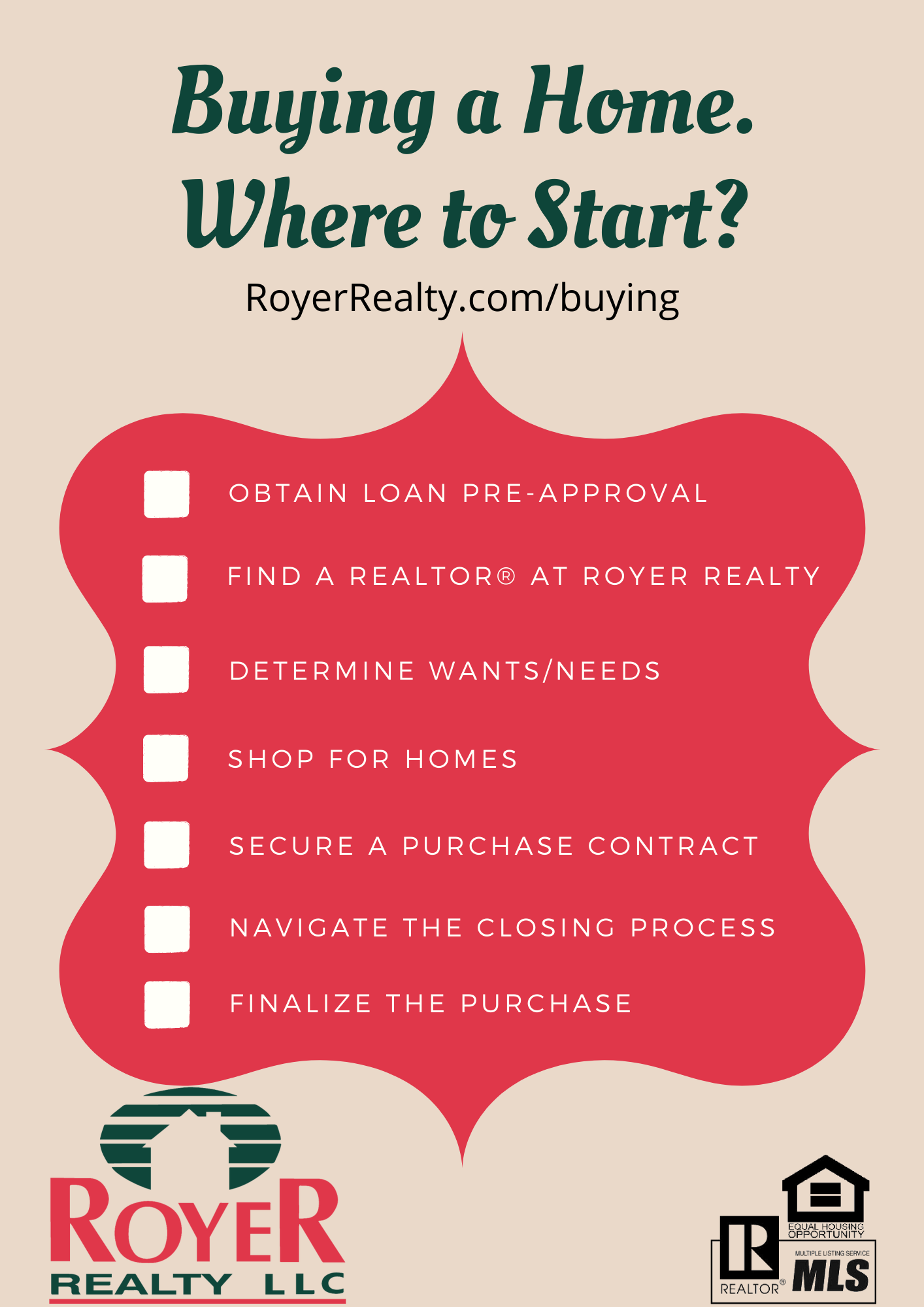
Buying a Home. Where to Start?

When buying a home, the first step is to determine your financing and obtain a preapproval letter for a loan.  This first step is important to help set the pace for the remainder of the process.  Knowing your price range and loan type will launch your home-search!  

Second, get a REALTOR® and we recommend us!  We have many great agents available and you can pick one who can guide you through the process from start to finish.

Next, determine what you want in a home: location, size, style, features, time-frame to move, etc.  Want a basement?  Need to be close to work/school?  These search criteria help yourself and your REALTOR® find the best suited homes available on the market.

Then, secure a purchase contract.  This means making an offer through your REALTOR® to purchase a home. A seller can accept, reject or counteroffer the terms you present in your offer.  Your REALTOR® will help you negotiate and get your purchase contract accepted.  Get everything in writing and all parties to the offer must sign to secure your purchase.

Navigate the closing process means having contingencies meet, doing inspections, lender's appraisal and more.  Your REALTOR® will continue to guide you along the way!

Finalize your purchase.  Once you have completed all the requires for your purchase, you can schedule a closing date with the selected title company and get ready to close.  At the closing, you'll sign documents and finalize your purchase.  

Hope you find this brief summary helpful!  Contact Royer Realty LLC to start your home-buying process today! 

Posted in Buyers, Resources
Oct. 8, 2021

Auctions

Auction Services

Contact Aaron Brown with any auction questions!
937-869-0584
Aaron@AaronBrownAuctions.com

Posted in Office News, Resources
Oct. 4, 2021

3D Digital Twins

We have great technology available to create 3D digital twins (virtual tours) of homes for sale!  If you are a seller and would like your home to have a digital twin, ask your listing agent for more information. If you are a buyer and the home for sale currently has a digital twin, the link will be visible on the detail pages on RoyerRealty.com and Realtor.com.  Within the virtual tour from a web browser, phone or tablet, you can browse each room in a 360 degree setting, view a "dollhouse" model, view each level and its floor plan, measure anything, and share with your friends! You can even download an app to view a home with virtual reality goggles!

Posted in Marketing
Sept. 30, 2021

Referrals

We love referrals!  If someone you know is looking to buy or sell in the Logan County Ohio area, refer your friends to Royer Realty.  We cooperate with referrals with other brokerages too.  Contact us for more details.

Refer A Friend

Posted in Marketing
Sept. 27, 2021

New Agent - Jim Berton

New Agent - Jim Berton


I am a native of Logan County and life long resident of Bellefontaine. I am a 1995 graduate of Bellefontaine High School, after graduation I attended The Ohio State University. I am married to my wife Helena, we have a daughter Kameren, two Boxer dogs and a cat that rounds out our family. In my free time you can find me watching or attending a sporting event, spending time with my family, painting, DIY projects, or working in my yard. I have a diverse work history, including owning my own business. For the last 15 years I have been in the project management field. This has taught me organization, communication, attention to detail, and people skills, all of which I feel will serve me well in my real estate career. I am excited and proud to be a member of the Royer Realty teamed I look forward to helping you with the process of buying or selling your next home. 

Posted in Office News